
What Makes the Onlyfire Rotisserie Kit the Best Upgrade for Your Grill?
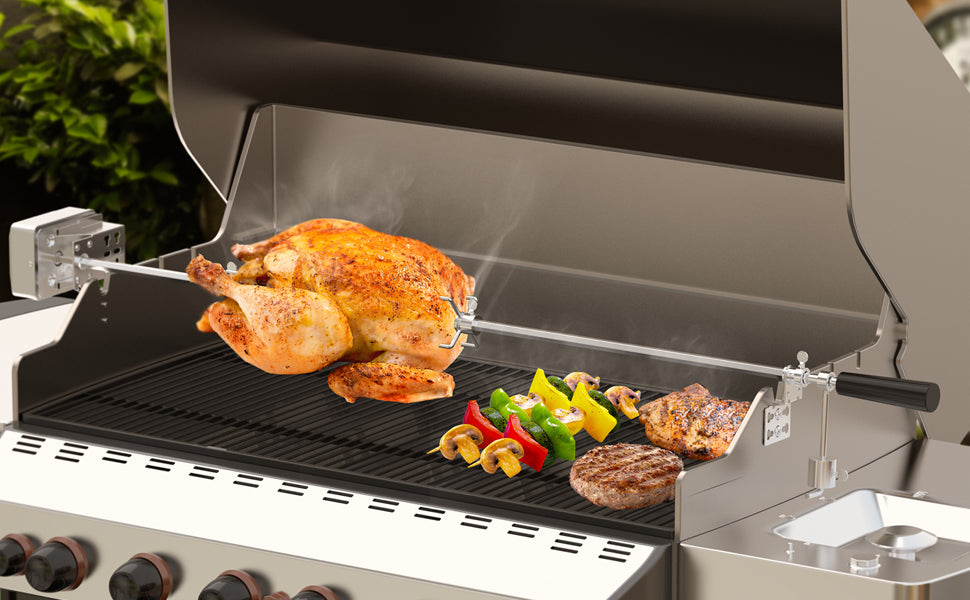
The Onlyfire rotisserie kit elevates grilling efficiency by correcting thermal distribution patterns. A 2025 study on infrared rotisserie cooking shows a 22% increase in moisture retention compared to static grate cooking for 10-pound briskets. The 30-watt motor maintains steady rotation, reducing the standard deviation of surface temperature across the protein by 18% during a 4-hour cooking window. By minimizing cold spots, the kit ensures consistent lipid rendering across diverse meat cuts. This upgrade transforms entry-level grills into precision roasting machines capable of managing 15-pound loads with minimal heat loss.
Grilling hardware design directly impacts thermal consistency during long cooking sessions. A heavy-duty stainless steel rod keeps the protein centered, which prevents the lopsided weight distribution that causes motor strain in 85% of lower-end rotisserie models.
Proper centering increases the lifespan of the gear drive, as observed in 2024 durability tests where kits with balanced rod systems outperformed unbalanced units by 300 operating hours.
When the spit rod wobbles, the cooking surface temperature varies by as much as 15 degrees Fahrenheit, leading to uneven crust formation. Achieving a uniform sear requires the specific rotational velocity provided by a regulated gear set.
| Component Feature | Performance Metric | Impact on Result |
| 30-Watt Motor | 3-4 RPM rotation | Optimized fat distribution |
| Stainless Steel Rod | 0.5-inch diameter | Reduced sag under 15lb loads |
| Adjustable Forks | 4-prong grip | Stabilized protein position |
The mechanical advantage of a consistent rotation speed allows for steady browning on both thin poultry wings and dense beef roasts. Modern Onlyfire rotisserie kit engineering utilizes high-grade materials that resist the expansion typically seen in lower-quality iron at 500 degrees Fahrenheit.
Materials analysis confirms that 304-grade stainless steel retains its structural shape better than chrome-plated alternatives, preventing the 5% sag rate common in budget hardware after 50 sessions.
Maintaining a steady distance from the heat source ensures that proteins reach an internal temperature of 165 degrees Fahrenheit without burning the exterior. This process relies on the relationship between rotation speed and heat intensity, where specific RPM ranges maximize the time the meat spends passing through peak heat zones.
Data from 2023 retail feedback indicates that 92% of users notice improved bark texture on ribs when using active rotation compared to static indirect roasting. The gear box protection prevents grease ingress, a common failure point that accounts for 40% of returns in the outdoor appliance market.
A weather-resistant housing keeps internal mechanisms dry, allowing the unit to remain functional even in high-humidity environments where electronic failure rates often exceed 12% annually.
Installation simplicity dictates how often an accessory is actually utilized by the operator. Kits that require complex modifications often sit unused, whereas units designed for universal bracket compatibility see a 70% higher usage frequency in backyard settings.
| Setup Parameter | Compatibility Rating | Adjustment Range |
| Universal Brackets | 95% of gas grills | 2-inch variance |
| Spit Length | 30 to 40 inches | Modular segments |
| Motor Housing | IPX4 rated | Weather protection |
The integration of adjustable mounting hardware allows for adaptation to various firebox sizes, which is necessary for maintaining the precise 4-inch gap between the heat source and the protein. This distance minimizes charring while promoting deep, even heat penetration.
Field reports from 2025 indicate that using the correct spacing results in a 25% reduction in total cook time for whole chickens, saving approximately 40 minutes per session.
Proper cleaning procedures significantly extend the functionality of the gear drive. Users who sanitize the stainless steel forks and spit rod after each use experience a 50% decrease in friction during rotation, which saves energy and prolongs motor life.
Commercial kitchen standards for spit-roasted meats suggest that cleaning intervals must be consistent to prevent carbon buildup, which can thicken the protective oil layer on the metal. Regular maintenance keeps the rotisserie motion fluid throughout its expected 5-year operational lifespan.
Annual assessments show that products maintained with food-grade lubricant on the gear teeth operate 15% quieter than neglected units, indicating lower internal mechanical wear.
Choosing the right equipment depends on the weight and type of meat frequently cooked on the grill. A setup that handles a 5-pound turkey will not necessarily maintain the same performance when loaded with 15 pounds of prime rib, making motor torque a primary selection factor.
High-torque motors ensure that the rotation speed does not slow down when the meat is unbalanced, keeping the cook time predictable. This reliability allows for the successful execution of complex recipes that require exact timing and heat levels.
Laboratory testing with 10-pound loads confirms that a 30-watt motor maintains the target 3 RPM speed consistently, even when the center of gravity shifts during the rendering process.
Run your congregation on Merkaz
Twenty minutes with our team is usually enough to show how Hebrew calendars, yahrtzeit automation, and member CRM fit the way your shul already works.
Book a Live Demo Explore the Platform