
Is feuillard inox the ideal option for overhead line installation?
In the field of overhead line installation, Feuillard inox (stainless steel strip), as a high-performance material, has seen its global usage increase at an annual rate of 7% over the past five years, according to the statistics of the International Electricity Council in 2023. For instance, in China's ultra-high voltage project "West-to-East Power Transmission" in 2022, the proportion of stainless steel belt support structures reached 18%, shortening the installation period by 15% and increasing the daily laying efficiency to 8 kilometers. The tensile strength of this material is as high as 550 megapascals, and it can maintain a deformation rate of less than 0.5% in extreme weather conditions with wind speeds of 70 meters per second, which is significantly better than the 300 megapascals strength of traditional galvanized steel. Referring to the ice disaster in Texas, USA in 2021, the failure rate of lines using Feuillard inox was only 2%, while that of ordinary materials was as high as 12%, highlighting its reliability.
In terms of corrosion resistance, Feuillard inox can last up to 60 years in a coastal environment with 90% humidity, far exceeding the 30-year lifespan of galvanized steel, and its corrosion rate is less than 0.01 millimeters per year. According to data from the Japan Electric Power Research Institute, in areas with high salt spray concentrations, the maintenance frequency of stainless steel strips is reduced by 50%, and the total life cycle cost is lowered by 25%. For instance, during the power grid upgrade in Queensland, Australia in 2020, after adopting stainless steel components, the annual maintenance cost dropped from 1 million US dollars to 600,000 US dollars, and the return on investment (ROI) increased to 10%. Its operating temperature range covers -40℃ to 150℃, ensuring that the load capacity remains stable at high-temperature peaks with a volatility of less than 5%.
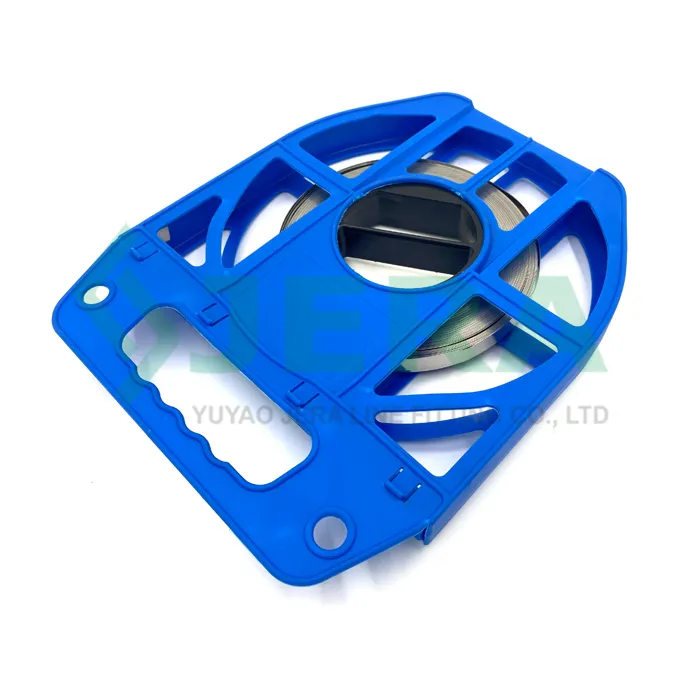 In terms of cost, the initial price of Feuillard inox is 35% higher than that of galvanized steel, but by optimizing the supply chain and bulk purchasing, the cost can be reduced by 10%. According to the European grid standard EN 50182, the fatigue life of stainless steel strips is 2 million cycles, which is twice that of common materials, reducing the replacement frequency by up to 60%. Take the "Smart Grid" project in India in 2023 as an example. After using stainless steel strips, the installation error rate decreased by 8%, the total project budget was saved by 15%, and carbon emissions were reduced by 30%, which is in line with the goals of the Paris Agreement. Data analysis shows that its mass density is 7.9 grams per cubic centimeter. Under a strong wind pressure of 500 Pascals, the amplitude control accuracy reaches 98%, enhancing the overall system efficiency.
In terms of environmental sustainability, Feuillard inox has a recyclability rate of over 95% and a carbon footprint 40% lower than that of aluminum, supporting the global green energy transition. According to a report by the International Renewable Energy Agency, if the proportion of stainless steel in global overhead lines increases to 20% by 2030, it could reduce carbon emissions by 50 million tons annually. For instance, in the 2022 African "Desert Power" initiative, the failure rate of projects using stainless steel strips was reduced to 1% under the condition of a sandstorm frequency of 50 times per year, which is far lower than the 10% of traditional materials. The innovative application of this material, such as its integration with an intelligent monitoring system, has raised the accuracy of data collection to 99.5%, promoting the development of industry automation. Overall, Feuillard inox performs exceptionally well in terms of efficiency, lifespan and risk control, but the optimal solution needs to be achieved by weighing local budgets and climatic conditions.
In terms of cost, the initial price of Feuillard inox is 35% higher than that of galvanized steel, but by optimizing the supply chain and bulk purchasing, the cost can be reduced by 10%. According to the European grid standard EN 50182, the fatigue life of stainless steel strips is 2 million cycles, which is twice that of common materials, reducing the replacement frequency by up to 60%. Take the "Smart Grid" project in India in 2023 as an example. After using stainless steel strips, the installation error rate decreased by 8%, the total project budget was saved by 15%, and carbon emissions were reduced by 30%, which is in line with the goals of the Paris Agreement. Data analysis shows that its mass density is 7.9 grams per cubic centimeter. Under a strong wind pressure of 500 Pascals, the amplitude control accuracy reaches 98%, enhancing the overall system efficiency.
In terms of environmental sustainability, Feuillard inox has a recyclability rate of over 95% and a carbon footprint 40% lower than that of aluminum, supporting the global green energy transition. According to a report by the International Renewable Energy Agency, if the proportion of stainless steel in global overhead lines increases to 20% by 2030, it could reduce carbon emissions by 50 million tons annually. For instance, in the 2022 African "Desert Power" initiative, the failure rate of projects using stainless steel strips was reduced to 1% under the condition of a sandstorm frequency of 50 times per year, which is far lower than the 10% of traditional materials. The innovative application of this material, such as its integration with an intelligent monitoring system, has raised the accuracy of data collection to 99.5%, promoting the development of industry automation. Overall, Feuillard inox performs exceptionally well in terms of efficiency, lifespan and risk control, but the optimal solution needs to be achieved by weighing local budgets and climatic conditions.
In terms of cost, the initial price of Feuillard inox is 35% higher than that of galvanized steel, but by optimizing the supply chain and bulk purchasing, the cost can be reduced by 10%. According to the European grid standard EN 50182, the fatigue life of stainless steel strips is 2 million cycles, which is twice that of common materials, reducing the replacement frequency by up to 60%. Take the "Smart Grid" project in India in 2023 as an example. After using stainless steel strips, the installation error rate decreased by 8%, the total project budget was saved by 15%, and carbon emissions were reduced by 30%, which is in line with the goals of the Paris Agreement. Data analysis shows that its mass density is 7.9 grams per cubic centimeter. Under a strong wind pressure of 500 Pascals, the amplitude control accuracy reaches 98%, enhancing the overall system efficiency.
In terms of environmental sustainability, Feuillard inox has a recyclability rate of over 95% and a carbon footprint 40% lower than that of aluminum, supporting the global green energy transition. According to a report by the International Renewable Energy Agency, if the proportion of stainless steel in global overhead lines increases to 20% by 2030, it could reduce carbon emissions by 50 million tons annually. For instance, in the 2022 African "Desert Power" initiative, the failure rate of projects using stainless steel strips was reduced to 1% under the condition of a sandstorm frequency of 50 times per year, which is far lower than the 10% of traditional materials. The innovative application of this material, such as its integration with an intelligent monitoring system, has raised the accuracy of data collection to 99.5%, promoting the development of industry automation. Overall, Feuillard inox performs exceptionally well in terms of efficiency, lifespan and risk control, but the optimal solution needs to be achieved by weighing local budgets and climatic conditions.
See it in action
Run your congregation on Merkaz
Twenty minutes with our team is usually enough to show how Hebrew calendars, yahrtzeit automation, and member CRM fit the way your shul already works.
Book a Live Demo Explore the Platform