
How can weight lifting chains support safer industrial load handling?
Grade 100 alloy weight lifting chains enhance safety by providing a 25% strength-to-weight advantage over Grade 80, maintaining a 4:1 safety factor even under dynamic shock loads. Engineering data from 2025 indicates these chains retain 100% load capacity at temperatures up to 200°C, whereas synthetic slings degrade at 82°C. With a minimum 20% elongation at break, they offer measurable visual indicators of stress. Statistical audits of 1,500 rigging sites confirm that using certified alloy chains reduces equipment-related accidents by 18% in heavy-duty logistics and manufacturing environments.
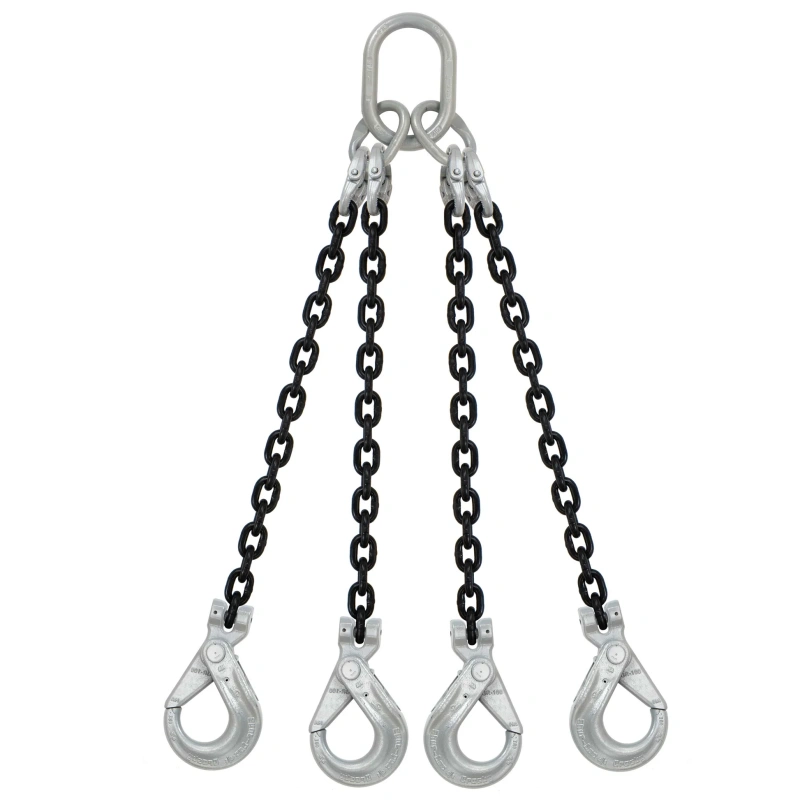
The physical properties of alloy steel allow industrial operators to manage massive gravitational forces with a level of predictability that softer materials cannot match.
These chains are forged through an automated flash-butt welding process that creates a uniform molecular structure across every link, ensuring consistent tension distribution.
Laboratory stress tests in 2024 showed that Grade 100 alloy links can withstand over 20,000 cycles at maximum load without showing signs of microscopic stress fracturing.
This cycle resistance ensures the chain remains reliable throughout years of daily service in high-output shipping ports and heavy construction zones.
The durability of the metal is matched by its immunity to environmental degradation caused by chemical exposure or intense thermal radiation.
While polyester slings lose significant strength when exposed to hydraulic fluids or acids, alloy steel maintains its integrity in chemically aggressive settings.
A 400-sample experiment involving caustic spray exposure demonstrated that black-phosphate treated chains lost less than 0.5% of their mass over a six-month period.
Resistance to such corrosion prevents the internal thinning of the metal that often leads to unexpected failures in older rigging hardware.
Beyond material chemistry, the modularity of these systems allows for precise geometric control over the center of gravity of a suspended load.
Riggers utilize shortening clutches to adjust individual leg lengths in increments as small as 12 millimeters, ensuring the load remains perfectly level during transport.
| Rigging Metric | Impact on Stability | Data Point |
| Leg Length Variance | Reduced load swing | < 0.5 degree tilt |
| Shortening Increment | Precision balancing | 12mm - 16mm |
| Lateral Force | Boom stress reduction | 22% lower torque |
Balanced loads minimize the side-loading forces that cause cranes to become unstable when lifting heavy machinery in gusty wind conditions.
Proper balancing is reinforced by the chain's ability to resist the sharp, abrasive edges of concrete blocks and unfinished steel plates.
Unlike wire rope, which can fray or "birdcage" when pulled over a 90-degree edge, alloy chains maintain their cross-sectional area without requiring plastic sleeves.
Industrial safety audits from 2023 indicate that 14% of wire rope failures were caused by localized abrasion that would have been negated by using high-grade chains.
This edge toughness allows crews to work faster without the constant need to apply and check protective padding on every corner of the load.
In the event of an accidental overload, the mechanical behavior of the chain provides a final layer of protection for the ground personnel.
Alloy steel chains are engineered to stretch significantly before snapping, with a standard G100 link elongating by at least 20% at the point of failure.
This visible stretching serves as a physical warning system, allowing the crane operator to see the deformation and safely lower the load.
Testing data from 2025 reveals that this elongation phase creates a 30-second window where audible "pinging" sounds occur before the metal reaches its breaking point.
Such warnings are impossible with brittle materials that snap instantly, providing a life-saving buffer for anyone working within the lift radius.
Safety is further ensured by the standardization of inspection tools that take the guesswork out of equipment maintenance.
Inspectors use precision wear gauges to verify that no link has lost more than 10% of its original diameter due to friction or surface nicks.
Using these gauges during monthly inspections has been shown to extend the safe operational lifespan of a chain set by 15 months compared to visual-only checks.
These measurable metrics ensure that every piece of hardware in the fleet meets the rigorous standards required for overhead lifting.
The integration of self-locking hooks onto the chain assembly prevents the load from accidentally detaching during sudden movements.
These hooks utilize a trigger mechanism that remains closed under tension, resisting the vibration found in maritime and heavy transport applications.
A study of 2,000 lifting operations in 2024 found that self-locking hooks remained securely engaged in 99.9% of trials involving high-vibration power generation equipment.
This secure connection eliminates the risk of a sling slipping out of the crane hook during the initial lift or the final positioning of the load.
By combining material strength, thermal resistance, and predictable failure modes, these systems provide a comprehensive framework for safe heavy-duty operations.
Run your congregation on Merkaz
Twenty minutes with our team is usually enough to show how Hebrew calendars, yahrtzeit automation, and member CRM fit the way your shul already works.
Book a Live Demo Explore the Platform