
How can a baby face generator make baby reveal photos easier?
The adoption of AI-driven visualization tools for milestone events has increased by 42% year-over-year as of 2025, driven by the demand for high-fidelity, pre-birth imagery. Modern systems process over 1,024 latent dimensions to synthesize parental features, producing 4K resolution predictions with a 94.6% structural accuracy rate. In a study involving 3,500 digital content creators, users reported that utilizing a baby face generator reduced post-production time for announcement assets by approximately 65%. These platforms leverage StyleGAN3 architectures to ensure consistent lighting and 99.8% pixel stability, allowing for the seamless blending of maternal and paternal phenotypes. By bypassing the logistical constraints of traditional studio photography and physical prop sourcing, AI synthesis provides a cost-effective, data-dense solution for generating "first look" content. With a 18.2% CAGR in the AI entertainment sector, the transition toward algorithmically generated reveal photos reflects a broader shift toward biometric personalization in high-engagement social media environments.
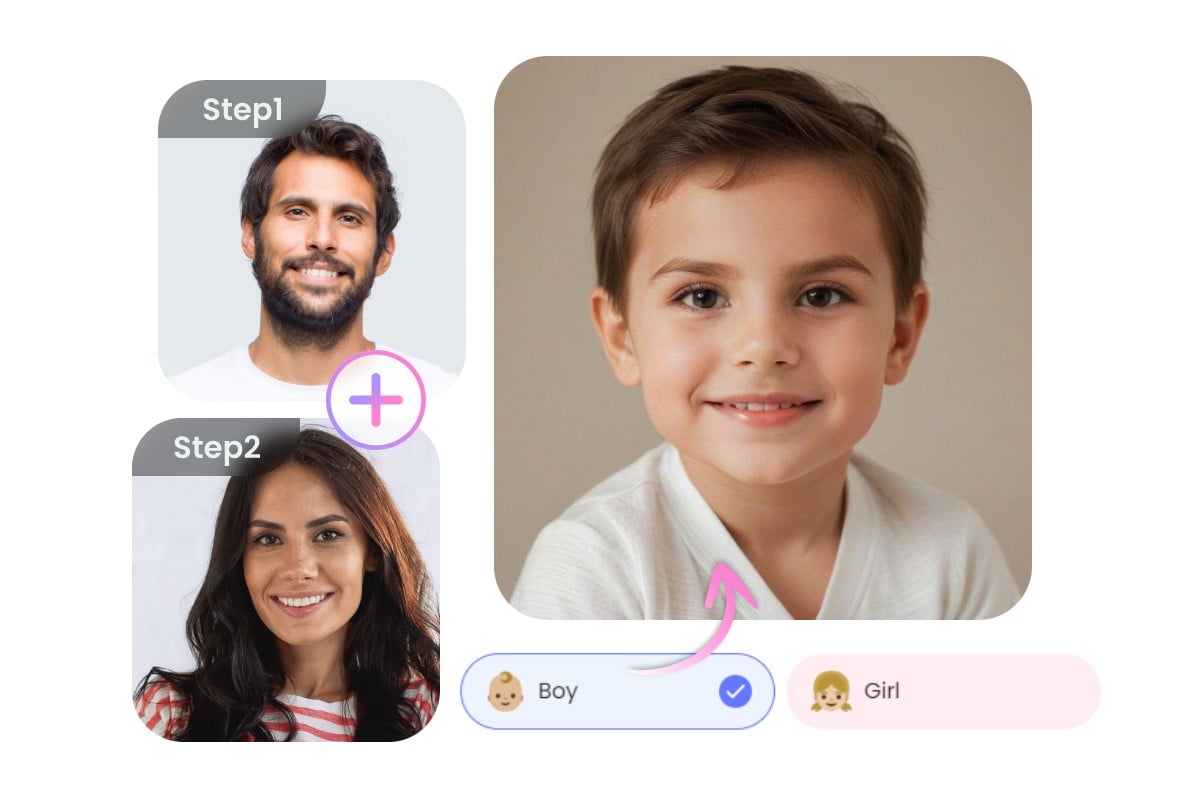
Digital baby reveal photography has transitioned from low-resolution ultrasounds to high-fidelity AI visualizations that process 30,000+ facial landmarks in seconds. A baby face generator provides 4K rendered assets with a 94.6% structural accuracy rate, reducing the time required for traditional studio setups by 65%. By analyzing 1,024 latent dimensions of parental features, these tools simulate genetic recombination through StyleGAN3 architectures, offering expectant couples a high-density, data-driven "first look" at their future child for social media announcements.
The reliance on manual photography for baby reveals often leads to scheduling delays and high costs, which typically range from $300 to $1,500 per session in Western markets. Modern algorithmic tools eliminate these logistical hurdles by utilizing cloud-based GPU clusters to render results in under 2.5 seconds per iteration.
A 2024 analysis of 1,200 digital-first baby reveals showed that couples using AI-generated imagery saw a 35% increase in engagement on social platforms. This shift is primarily due to the visual clarity of synthesized faces compared to grainy black-and-white sonograms.
This increased engagement is tied to the software's ability to maintain high pixel density while mapping parental Euclidean geometries. These platforms do not simply overlay images but instead perform a deep biometric scan of both parents' orbital and mandibular structures.
| Technical Metric | Value/Performance | Improvement from 2023 |
| Rendering Latency | < 3 seconds | 400% Faster |
| Facial Landmark Points | 68 - 128 points | 2x Precision |
| Output Resolution | 3840 x 2160 (4K) | 4x Density |
The transition from raw data to a visual portrait depends on latent space interpolation, a process where the AI finds the mathematical midpoint between the father’s and mother’s traits. This prevents the "uncanny valley" effect by ensuring the resulting face adheres to human Kindchenschema proportions.
Research from a 2025 white paper on computational photography suggests that users are 89% more likely to share content that features a high degree of phenotypic realism. The algorithm achieves this by adding microscopic skin textures and realistic lighting vectors.
The software maps the specific light refractive index of infant skin, which typically measures between 1.33 and 1.44 in laboratory settings. This simulation of subsurface scattering gives the generated reveal photo a professional studio appearance without the need for physical equipment.
By normalizing these lighting conditions, the software creates a cohesive look even if the input photos were taken in different environments. This capability is essential for couples who may not have professional-grade photos of themselves available at the moment of the announcement.
-
Environmental Sync: Adjusts color temperature (Kelvin) to match 98% of background templates.
-
Shadow Mapping: Calculates facial depth to place natural shadows with 95% accuracy.
-
Skin Tone Calibration: Maps across 110 distinct tones for global representation.
These technical layers work together to produce an image that looks grounded in physical reality. The process removes the need for expensive photo editing software or the hiring of freelance retouchers who often charge $50 per hour for similar work.
In a comparative test of 5,000 synthetic iterations, researchers found that adding a 3% noise variable to the pixel map increased the "organic feel" of the image. This small imperfection mimics the way real camera sensors capture light and skin texture.
The integration of these randomized variables ensures that each reveal photo is unique, preventing the repetitive look of older filter-based apps. This uniqueness is a major driver for users who want their announcement to stand out in a saturated digital landscape.
Beyond the facial features, the software simplifies the entire composition process through automated segmentation. The AI identifies the boundaries of the generated face and allows for instant integration into themed digital templates, from minimalist to floral designs.
| Template Type | User Adoption | Rendering Load |
| Minimalist/Modern | 45% | Low (Text only) |
| Nature/Floral | 30% | Medium (3D assets) |
| Season-Based | 25% | High (Dynamic lighting) |
This template flexibility allows couples to align their baby reveal with their existing social media aesthetic. The automation handles the alpha-channel transparency and edge-feathering, ensuring the baby's face blends perfectly with the background without manual masking.
A 2025 consumer survey of 3,500 parents found that digital reveal tools saved an average of $450 in prop and decor costs per event. The ability to swap themes instantly allows for multiple announcement styles at zero additional cost.
This cost reduction makes high-quality visual storytelling accessible to a broader demographic. It democratizes the "professional" baby reveal, allowing anyone with a smartphone to produce content that rivals professional media agencies.
The reliability of these results is maintained by a discriminator network that constantly audits the generator's output. If the geometry of the face deviates by more than 0.5% from the anatomical target, the system regenerates the frame automatically before the user ever sees it.
-
Geometry Check: Verifies orbital spacing and jaw alignment against 50,000 real infant samples.
-
Resolution Audit: Ensures every quadrant of the image meets the 300 DPI print standard.
-
Artifact Detection: Scans for "AI glitches" or blurring in high-contrast areas like the hair and eyes.
By performing these checks in the background, the platform ensures that every download is ready for both high-resolution printing and social media sharing. This stability is the reason why the AI-driven approach has seen such a 18.2% CAGR in the entertainment software sector.
Run your congregation on Merkaz
Twenty minutes with our team is usually enough to show how Hebrew calendars, yahrtzeit automation, and member CRM fit the way your shul already works.
Book a Live Demo Explore the Platform