
Perfume Factory Replies Compared: Warning Signs Buyers Overlook
Comparing perfume factories side by side is less about who has the polished presentation and more about who answers the same question the same way. When one seasonal brief goes out to three suppliers, the differences in format, missing answers and vague dates are usually the first warning signs, and they show up before anyone makes a sample. Use the comparison as a test of how a supplier works, not only of what it charges.
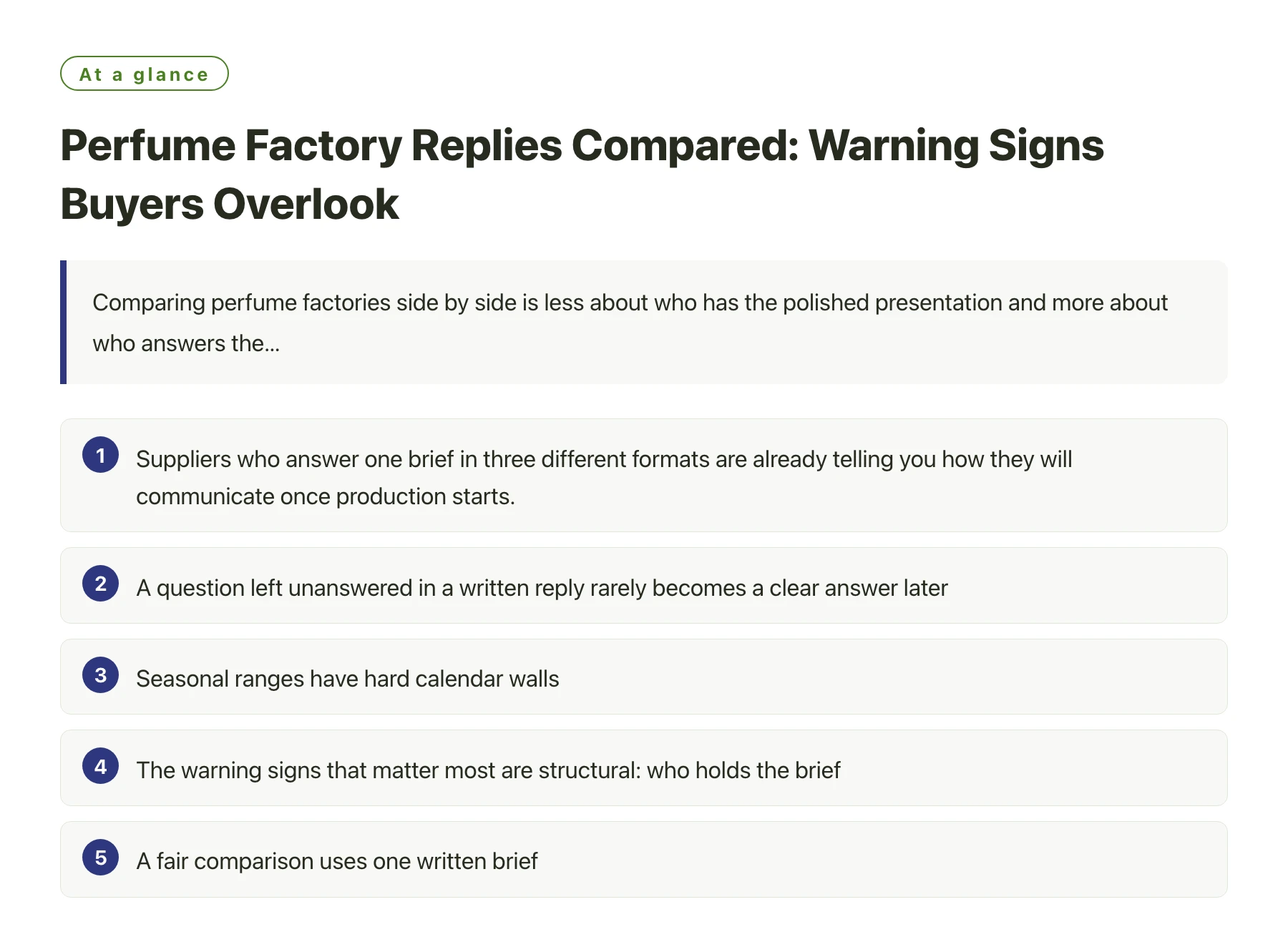
Key takeaways
- Suppliers who answer one brief in three different formats are already telling you how they will communicate once production starts.
- A question left unanswered in a written reply rarely becomes a clear answer later; it normally becomes an assumption inside the bulk order.
- Seasonal ranges have hard calendar walls, so a supplier who will not name a sampling date is a scheduling risk rather than a slow correspondent.
- The warning signs that matter most are structural: who holds the brief, who signs off the bulk standard, and who is accountable when the two drift apart.
- A fair comparison uses one written brief, one question set and one scoring sheet for every factory on the list.
- Price differences of a few percent are usually noise next to a difference in revision rounds, sampling dates or minimum order quantity.
Most buyers do not set out to compare factories on gut feeling. They set out with a brief, a target price and a launch date, and then the replies arrive: one as a spreadsheet, one as a paragraph in an email, one as a phone call summarised from memory. By the time the third answer is in, the temptation is to pick the neatest one rather than the most reliable one.
That is where a seasonal collection gets into trouble. Seasonal work compresses sampling, approval, decoration and shipping into a window that cannot move, because the range has to be on shelf before the season starts. A supplier who is slow to answer a question in February is a bigger risk in August than a supplier who quotes slightly higher but answers precisely.
This is a practical way to compare replies. It covers the signals worth investigating, the questions that reveal whether you are talking to a manufacturer or a middle layer, and a simple way to score several factories against the same set of facts.
Why replies are hard to compare in the first place
A written brief asks one question and receives three answers shaped by three different habits. One factory restates the brief and adds a costed line per unit. Another sends a capability document and a price range without confirming what is included. A third replies with questions of its own, which feels unhelpful until you notice that the questions are the most technically specific of the three.
None of those formats is automatically wrong. What matters is whether the same underlying facts are present: unit cost and what it covers, tooling and mould cost if decoration is involved, minimum order quantity per format, sampling cost and credit, expected lead times from approval to shipment, and a named person accountable for the project.
Different formats hide different answers
When a supplier answers in prose, the missing facts are easy to miss. Read each reply against the brief line by line and mark what is absent. A reply that never mentions fill weight, pump type or carton dimensions has not engaged with the physical product yet.
When a supplier answers with a capability document, check whether every claim in it is attached to a person, a date or a document. Certification and testing claims are worth verifying with the issuing laboratory rather than accepting a scanned page, and third-party testing bodies publish what their marks do and do not cover [1].
The seasonal clock makes comparison urgent
A seasonal range turns a normal sourcing decision into a scheduling decision. Sampling has to finish before decoration artwork is locked, and decoration has to finish before filling and packing. If a supplier cannot say when the first sample would land, the whole chain behind that date is unknown, and unknown dates compound.
It also helps to know what kind of supplier each reply comes from. The phrase OEM perfume production in Guangzhou covers a wide range of businesses, from plants that compound, fill and pack to trading offices that coordinate all three. Neither is automatically the better choice, but the two fail in different ways, and the comparison only means something if you know which one you are comparing.
Signals that deserve a second look
| Signal in the reply | What it can mean | What to ask next |
|---|---|---|
| The price is given as a single number with no breakdown | Cost drivers are being absorbed or guessed, so any change to the brief may not be costed predictably | Ask for the line items: compound, bottle, cap, decoration, filling, carton and testing |
| Lead time is stated as a range without a start point | The clock is being measured from a date the supplier controls, not from your approval | Ask for the number of working days from approved sample and deposit to shipment |
| No sampling fee is mentioned at all | Either sampling is bundled invisibly into unit cost, or the sample is not a formal project | Ask what a revision round costs and whether the fee is credited against the bulk order |
| Every question is answered with 'no problem' | Technical trade-offs are not being surfaced, which usually means they will surface later | Ask which part of the brief is hardest to hit and why |
| Minimum order quantity is quoted per component rather than per product | Decoration or bottle sourcing may force volumes far above the range you planned | Ask for the minimum per format, per colour and per decoration method |
| The contact changes between the first and second reply | The brief may be moving between a sales layer and a technical team without a single owner | Ask who will own the project from brief to shipment, by name |
None of these signals is proof of a bad factory. Each is a prompt to ask one more question, and the quality of the answer is the real evidence.
Warning signs that are really about process
Some signals are not about capability at all; they are about the absence of a process. A factory that cannot describe how a formula is locked, how a retained standard is stored, or how a bulk batch is checked against that standard is describing an informal workflow, even if its equipment is good.
Compliance is a useful lens here because it forces documentation. A fragrance supplied into a regulated market has to respect the use restrictions published in the IFRA standards, and those restrictions differ by product category [2]. A supplier that answers compliance questions casually, without asking which category and which market you are selling into, has not absorbed the brief.
Ask how the factory handles a brief that changes after the first sample. If the answer is a new project, a new quote and a new timeline, that is a legitimate commercial choice, but it is one you should know about before you build a seasonal calendar around it.
Questions that separate a factory from a trading desk
Manufacturing and trading both have a place in a supply chain, but they behave differently when something goes wrong. A trading company can often price a project faster because it is quoting someone else's capacity; a manufacturer can usually adjust a formula, a fill line or a decoration run directly.
The simplest way to tell them apart is to ask about the parts of the work that cannot be outsourced invisibly. Who compounds the fragrance? Who owns the filling line? Where does quality control happen, and who signs the release? If the answers describe partners rather than the supplier itself, that is not disqualifying, but you should map every handover, because each one is a place where a date or a specification can slip.
A structured question set is the fastest way through this. The list worth preparing is essentially the questions to ask a perfume factory, covering capacity, sampling, quality control and accountability, and it works best when you send the same questions in writing to every candidate and compare answers side by side. Xuelei, a fragrance manufacturer in Guangzhou, publishes a version of this list for buyers who want a starting point.
Running the comparison fairly
The comparison itself can create false signals. If you brief three factories at different levels of detail, the one with the fullest brief will look the most competent. If you give one candidate a target price and the others only a specification, the quotes are not comparable at all.
Send one brief, one question set and one scoring sheet. Score answers on the same rows: completeness, technical specificity, clarity of the sampling plan, realistic lead times, minimum order quantity, and whether a named person owns the project. Leave a column for the quality of the questions the supplier asks you, because that is where a real development team usually reveals itself. Buyers who want to know whether the whole scope can sit with one supplier, from compounding to filling and packing, will find that a factory that handles fragrance R&D and production answers a different question than a component broker does.
Two practical tests finish the job. First, ask each shortlisted factory for a sample of a current commercial product it has filled, not a sample made for the occasion; a production sample shows the standard it actually ships. Second, ask what happens when a bulk batch does not match the approved standard, and listen for a written procedure rather than a reassurance.
If the shortlist is entirely Chinese, it is worth comparing how each candidate organises production, because the city's supply base ranges from specialised filling houses to factories that compound, fill and pack in one plant. The differences show up in who you have to coordinate, not only in the quote.
What a seasonal collection changes about the shortlist
Seasonal work tends to reward fewer formats and deeper planning. A range of four formats with the same bottle family and one decoration method is easier to schedule, cheaper to fill and simpler to check than eight formats spread across three suppliers. The comparison should therefore include a question about how each factory would simplify the range, because a supplier that pushes back on complexity is often the one with production experience behind the answer.
It also helps to separate the order into what must ship together and what can follow. Gift sets, travel sizes and single bottles may not need the same production date. Splitting the schedule reduces the chance that one delayed component holds the entire seasonal launch, and it gives you a natural first batch to inspect before the rest is filled.
Keep the comparison evidence rather than impressions. Save every written reply, the date it arrived and the answer it gave to each question. When a project runs late or a batch drifts, that file is what turns a difficult conversation into a factual one.
Sources
- SGS: Cosmetics, Personal Care & Household Testing —— Testing, inspection and certification services for cosmetics and personal care, including microbiological, stability and safety testing aligned with cosmetics GMP.
- IFRA Standards Library (International Fragrance Association) —— The IFRA Standards Library lists the restrictions the fragrance industry applies to individual fragrance ingredients, based on safety assessments; it is the reference point for compliant fragrance formulation.
Frequently asked questions
How many perfume factories should I compare for a seasonal collection?
Three is usually enough to see the range of pricing and process, and few enough to brief properly. More than five tends to produce shallow replies rather than better information, because none of the candidates receives enough context to answer specifically.
Is a cheap quote a red flag on its own?
Not on its own, but an unexplained cheap quote is. Ask which line items are included and which are not: compound, bottle, cap, decoration, filling, carton, testing and freight are common places where a low unit price hides a cost that appears later.
What is the strongest single question to ask a perfume factory?
Ask what happens when the bulk order does not match the approved sample. The answer shows whether there is a documented quality process with retained standards and a defined resolution path, or only an intention to do better next time.
Should I give every factory the same target price?
Yes, if you give it to all of them or to none of them. A target price shared with one candidate and withheld from the others makes the quotes incomparable and usually pushes the informed candidate towards a specification that is cheaper than the brief requires.
How do I compare factories when their quotes arrive in different formats?
Rebuild each quote into one table with fixed rows, then mark any row that is missing rather than guessing a value. Missing rows are part of the comparison result and often matter more than the numbers that are present.
Run your congregation on Merkaz
Twenty minutes with our team is usually enough to show how Hebrew calendars, yahrtzeit automation, and member CRM fit the way your shul already works.
Book a Live Demo Explore the Platform